Field
The recording starts before you do. Everything after that — slicing, tuning, variants — happens on the same device.
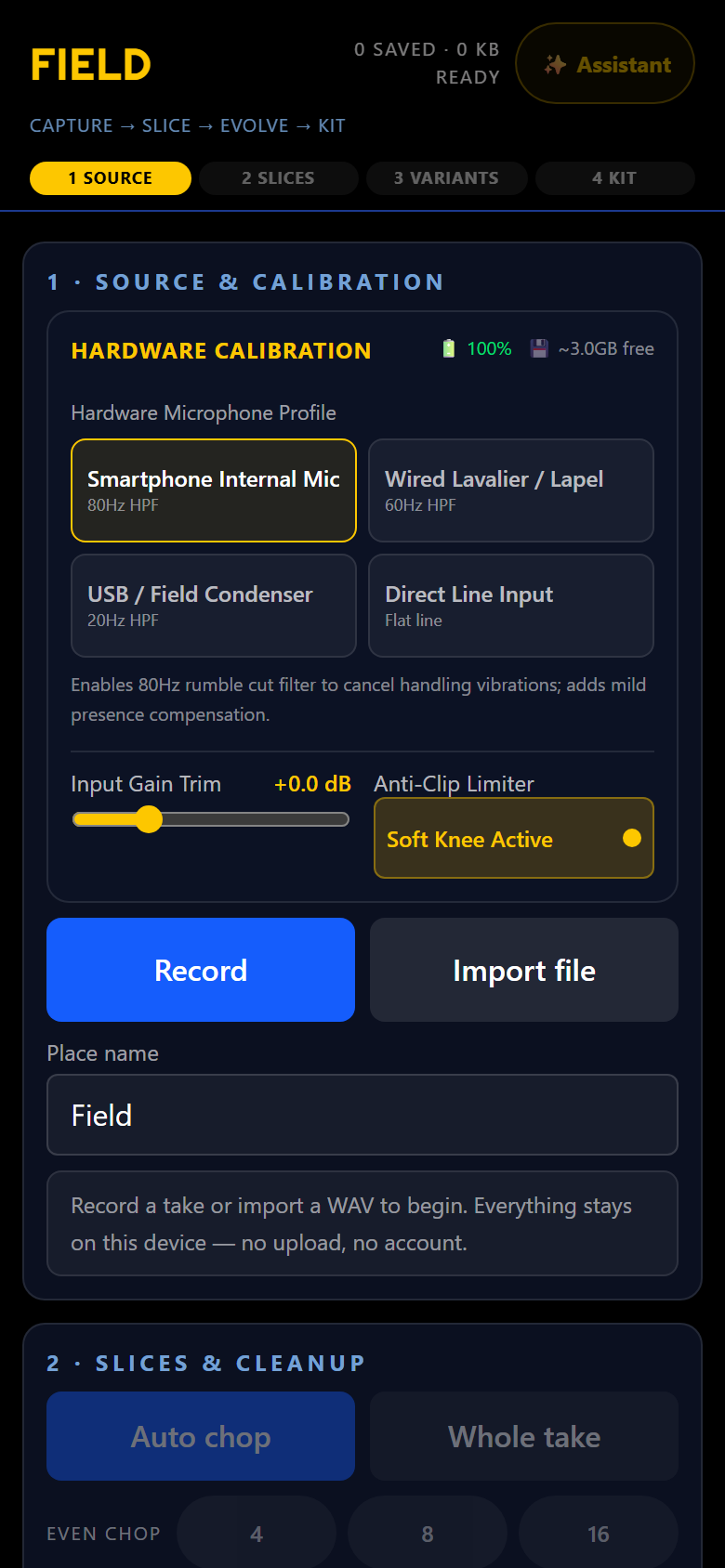
Field exists because the sound usually starts before the record button. It keeps a rolling one-second buffer, writes it in front of the take, then gives you the tools to cut the take into playable pieces without a laptop.
- Pre-roll1 s rolling buffer
- ProfilesInternal, lav, USB, line
- AnalysisOnset slicing, YIN pitch
- Output.ncbeat kit or WAV
Free in beta · $5 now · $3 member preorder
Capture
Choose a hardware profile before recording: smartphone internal mic, wired lavalier, USB/field condenser or direct line. The profile sets a high-pass (80 Hz for the phone, 60 Hz for a lav, 20 Hz for a condenser), a presence compensation curve, and arms a soft-knee anti-clip limiter. Gain trim is live, with a meter that shows headroom rather than a peak that has already clipped.
The pre-roll buffer is one second by default and configurable. When you press record, the buffer is snapshotted and prepended to the take. If the first sample is already near silence, no fade is applied; if the buffer starts mid-waveform, a 1 ms lead-in fade prevents a click. That distinction matters on percussion — a blanket fade would eat the attack.
Slices and cleanup
After capture, auto-chop runs onset detection and proposes slice markers. Accept all, adjust individual markers, or mark the whole take as one slice. Cleanup includes DC removal, normalisation, a noise gate and a short fade at each slice edge. Every edit is reversible until you commit the kit.
Tuning and variants
YIN pitch detection estimates the root of each slice. The variant grid evolves a slice through a seeded genome: transpose, formant, drive, filter and space move within bounded ranges, and the seed is saved so a variant can be reproduced exactly. A transient lock protects the first 15 ms of the attack from mutation.
Variants can be auditioned as a grid, kept or trashed. The grid re-keys when a variant's genome changes, so a refined sound does not get stranded as “not kept”.
Kits and export
Kept variants become a kit. A kit carries its slices, tuning, genome seeds and metadata in a .ncbeat package that Phone Beat and NC Studio open directly. Individual slices export as 24-bit WAV. Everything stays on the device; there is no upload step and no account.
Beta limits
iOS Safari suspends audio when the screen locks; keep the screen awake for long takes. The pre-roll buffer is memory-only, so a force-quit loses it. Storage quota varies by browser; export the kit when a session matters. The noise gate is broadband, not spectral — it removes room floor, not a specific hum.